Watsonia meriana
Wild watsonia · bugle lily · lakpypie · waspypie

Tall spring bugles rising from a hidden corm
Watsonia meriana is a winter-growing perennial that survives the dry season as an underground corm wrapped in tough fibrous tunics. Each plant produces several erect, sword-shaped leaves with strongly thickened margins and midribs. The flowering stem can rise well above a metre, carrying an open spike of 8–25 elegant tubular flowers.
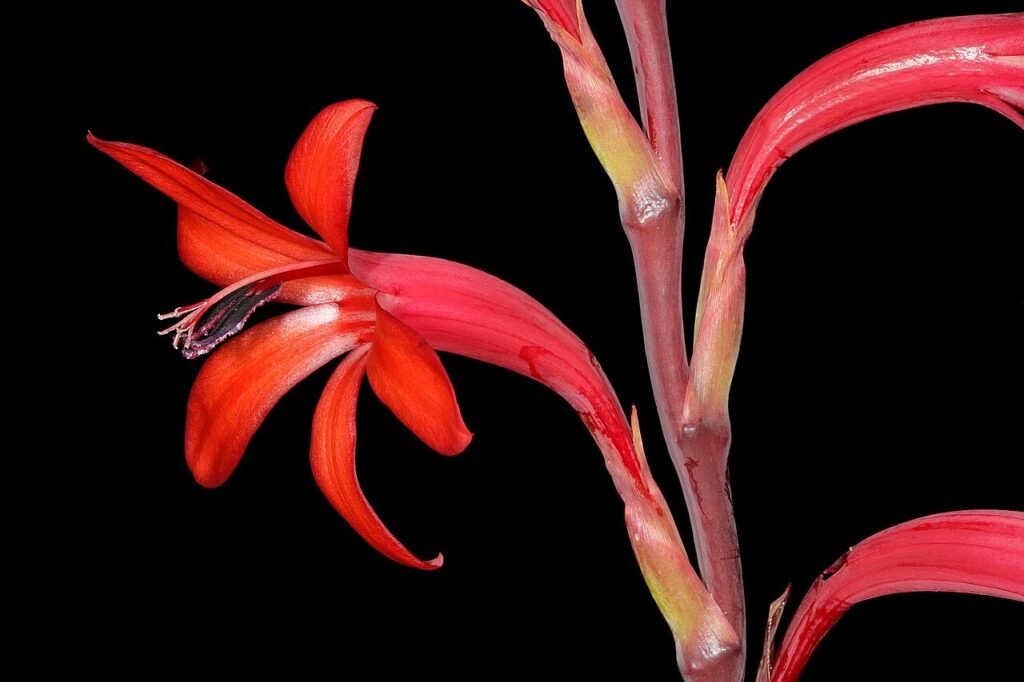
The flowers range from pale pink and mauve to orange-red, with a long curved tube and spreading lobes. Flowering is mainly in late winter and spring. Nectar-seeking birds and insects visit the conspicuous spikes and move pollen between flowers. After flowering, dry capsules release firm, angular seeds.
The typical variety, W. meriana var. meriana, is a South African endemic of the Northern and Western Cape. It occurs in open fynbos and renosterveld, often on sandstone-derived or seasonally moist ground. The plants photographed here are this indigenous typical variety, not the prolific bulbil-forming variety that has become invasive overseas.
SANBI assesses Watsonia meriana var. meriana as Least Concern, with a stable population. Restoring it in the Park nevertheless matters: the species adds seasonal colour, supports nectar visitors and returns a characteristic Cape geophyte to the local plant community.
The underground corm is a storage organ rather than a true bulb. Seasonal growth allows the plant to use the Cape’s wetter months, then withdraw below ground during the summer rest. Keeping the leaves intact after flowering helps support the following year’s display.
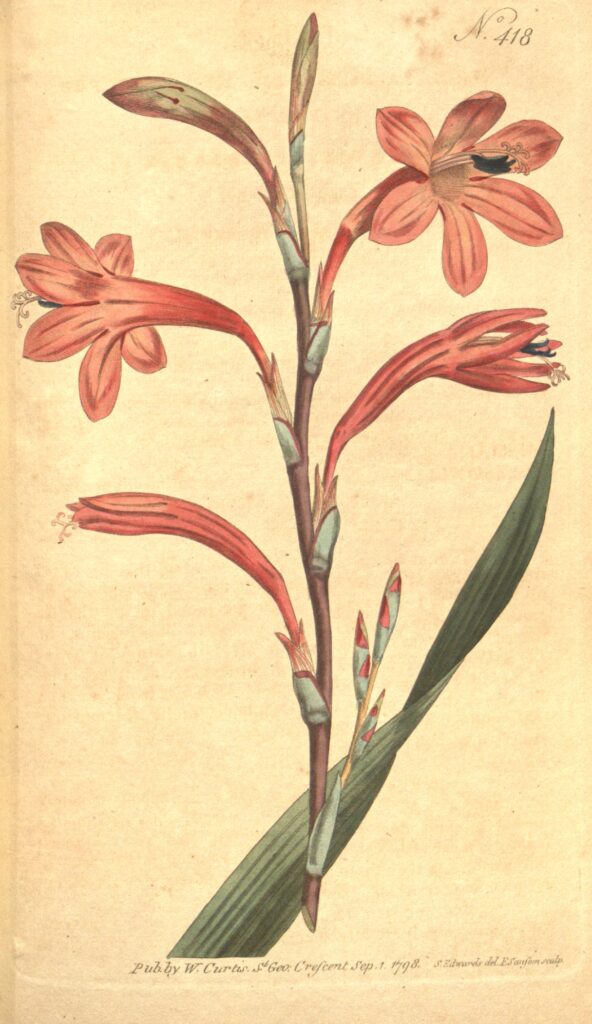
A name with history: Carl Linnaeus first described the species as Gladiolus merianus in 1753. Philip Miller later transferred it to Watsonia , a genus named for the English botanist Sir William Watson. The species name meriana honours the pioneering naturalist and artist Maria Sibylla Merian. A striking hand-coloured portrait appeared as plate 418 in William Curtis’s The Botanical Magazine in 1798.