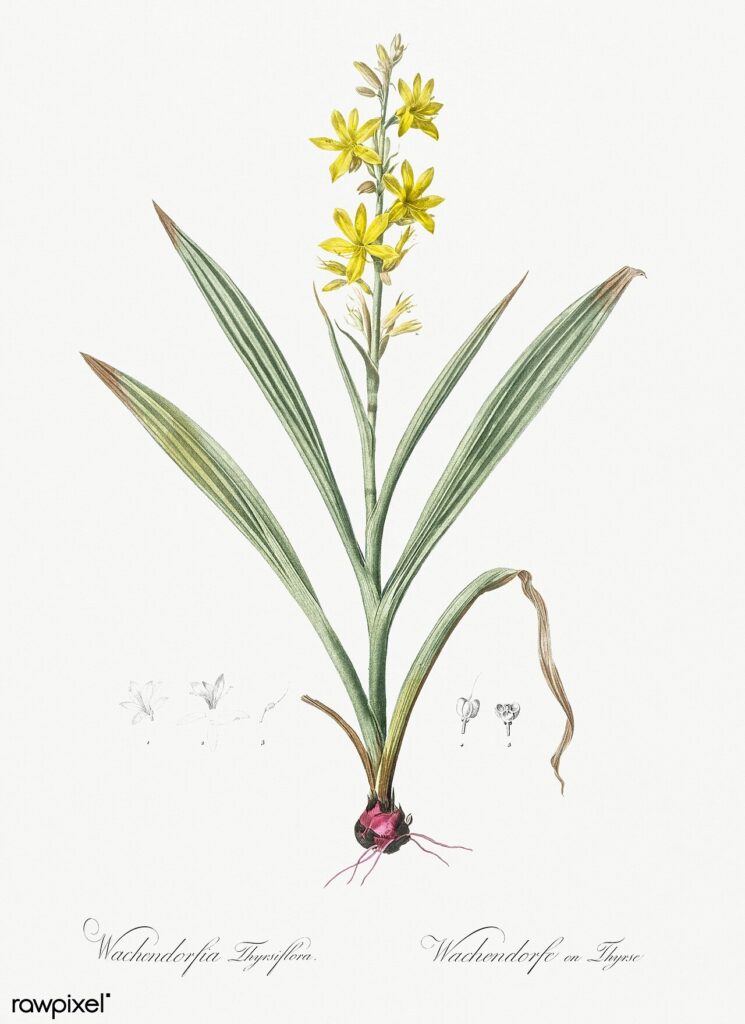
Wachendorfia thyrsiflora
Marsh butterfly lily · bloodroot · redroot · rooikanol
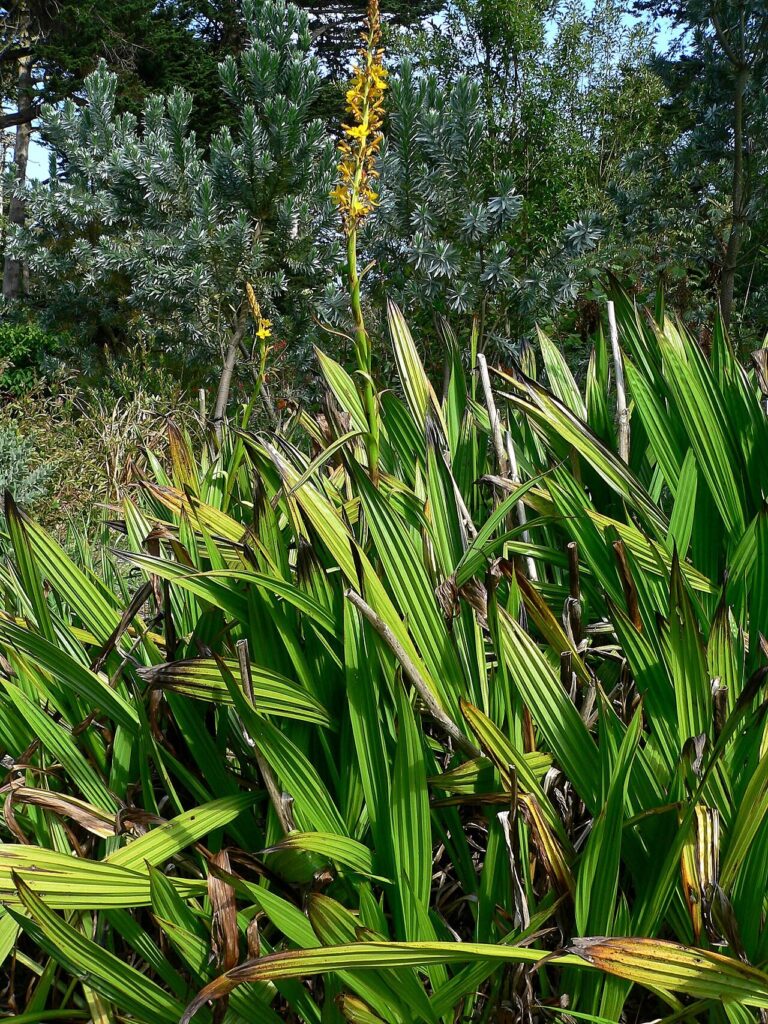
Golden flower towers rooted in the wet ground
Wachendorfia thyrsiflora is a large evergreen geophyte that grows from a fleshy, branching underground rhizome. Broad, sword-shaped leaves rise in bold pleated fans, usually 600–1,000 mm tall. In flower, sturdy stalks may reach 2.5 m and carry dense cylindrical clusters of brilliant golden-yellow blooms.
Flowering is mainly from September to December. Each golden flower bears darker markings and an unusual arrangement called enantiostyly: the style bends left in some flowers and right in others. This can encourage cross-fertilisation. Honeybees are frequent visitors, but a visitor is not necessarily an effective pollinator; the relative contributions of different insects remain less clearly established.
The plant is found from the Olifants River Valley and Cape Peninsula eastwards to Humansdorp, growing beside streams and in permanent marshes and seepages. Its underground tissues contain vivid red arylphenalenone pigments—the source of the names bloodroot, redroot and rooikanol. Dense clumps expand through new rhizomes and long stolon-like outgrowths.
SANBI assesses the species as Least Concern. Nevertheless, restoring healthy wetland vegetation matters locally. Its substantial clumps bring height and cover to damp ground and offer a striking contrast with finer rushes and sedges. The pleated leaves remain conspicuous outside the flowering season, making the plant a useful landmark beside a stream as well as an impressive seasonal display.
A name with history: The plant entered European botanical literature through a Cape specimen collected by Henrik Bernard Oldenland in the late seventeenth century. Leonard Plukenet described it in 1700, and Johann Philipp Breyne illustrated it in 1739 as Asphodelus latifolius . Carl Linnaeus formally published the name Wachendorfia thyrsiflora in 1759. Pierre-Joseph Redouté later portrayed it in his remarkable, famous work, Les Liliacées in 1805. The genus honours the German botanist Evert Jacob van Wachendorff, while thyrsiflora refers to the dense thyrse-like flower cluster.