
Tarchonanthus littoralis
Coastal camphor bush · kuskanferbos · isiduli selindle · igqeba-elimhlophe
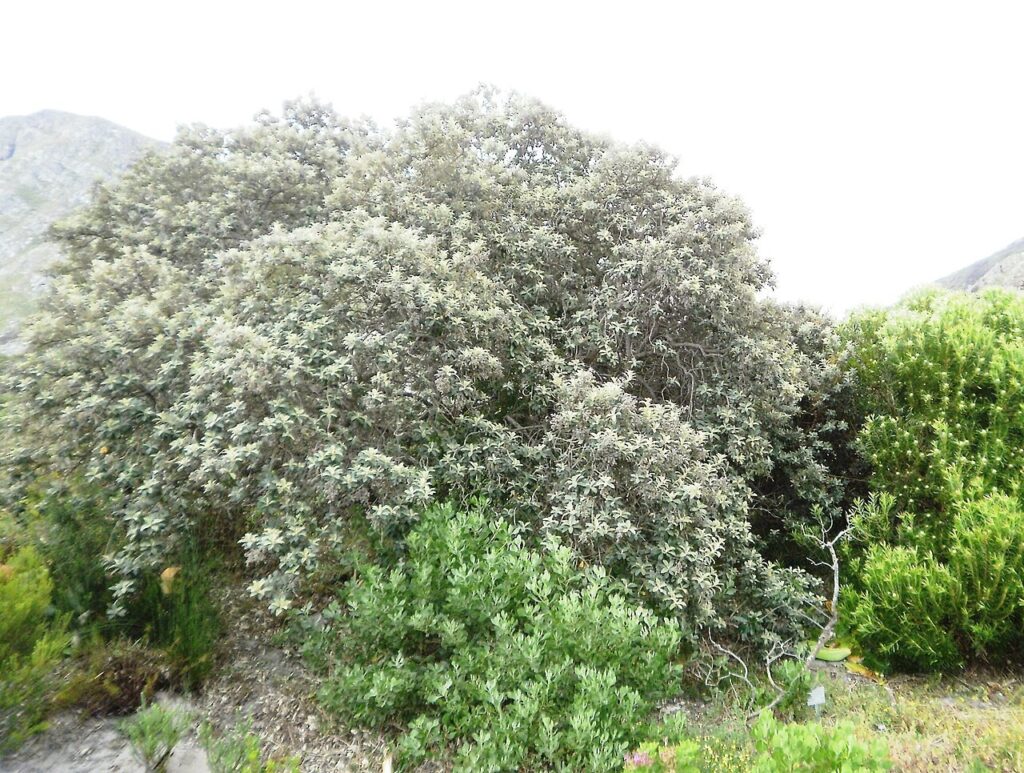
A wind-shaped coastal tree with silver-backed leaves
Tarchonanthus littoralis is a dense evergreen shrub or small tree, commonly 3–5 m tall but occasionally larger. Coastal wind often shapes it into a broad, compact crown. Its rough grey-brown bark, resilient branches and ability to grow in nutrient-poor sand make it an excellent pioneer, windbreak and screening plant.
The leathery, elliptic leaves are dull green and slightly puckered above, but densely felted pale grey or white beneath. When the leaves move in the wind, the contrasting surfaces give the crown a silvery shimmer. Both leaves and wood release a strong camphor-like scent when crushed or cut.
The species is dioecious: male and female flowers are normally borne on separate trees. Tiny cream flowers are packed into heads and then into large branched clusters, with peak flowering from December to March. In female plants, each fruit develops a plume of white woolly hairs, producing conspicuous cottony seed heads that can remain decorative for months.
This South African endemic follows the coast from the Cape Peninsula through the southern and Eastern Cape to KwaZulu-Natal. It grows on hillsides, dunes and riverbanks, especially in littoral thicket and other exposed coastal vegetation. The leaves provide browse, flowers feed insects, and the wind-borne fruits disperse readily into open ground.
SANBI assesses the coastal camphor bush as Least Concern. It is widespread along the southern and eastern coast, its population is stable, and an isolated natural subpopulation occurs on the Cape Peninsula. Locally, protecting mature trees and coastal vegetation remains important.
A name with history: The coastal plant was long included under Tarchonanthus camphoratus. In 2002 botanist Pieter Phillipus Johannes Herman revised that complex and described T. littoralis as a distinct species, using differences in leaves, flowerheads, flowering time and distribution. The epithet littoralis means “of the shore”, an apt name for a tree shaped by coastal conditions.

