
Struthiola dodecandra
Sweet gonna · pink featherhead · soetgonna · heuningblommetjie
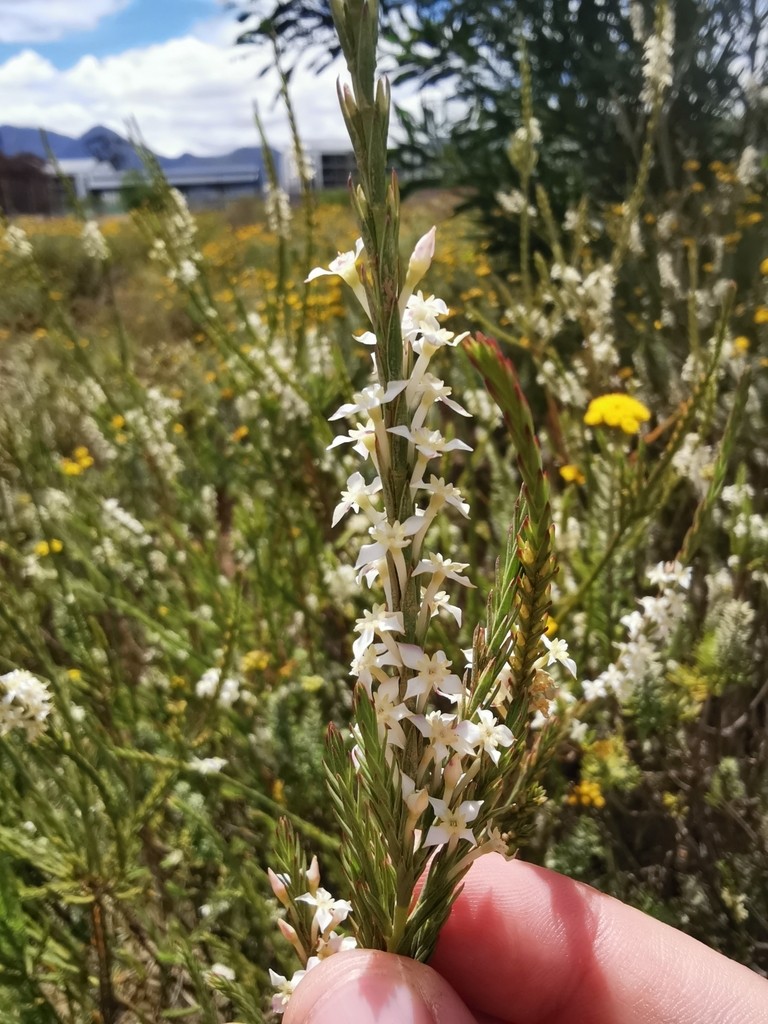
Small flowers with a powerful night perfume
Struthiola dodecandra is a slender evergreen shrublet, generally up to about 800 mm high. Its lax, four-angled stems carry opposite, narrow lance-shaped leaves. Long flower spikes form at the tips of the branches, giving the plant its English name, pink featherhead.
The small tubular flowers range from white to blush pink. During the day their fragrance can be faint, but after sunset they release a strong, sweet perfume. This nocturnal signal attracts moths, which hover at the flowers and probe the narrow tubes for nectar while transferring pollen.
Flowering may occur throughout the year, making the plant attractive well beyond a single season. It grows naturally on damp flats and lower slopes from the Cape Peninsula eastwards to Bredasdorp and Knysna. In cultivation it prefers sun, moisture-retentive but aerated soil and a position that does not dry out completely.
SANBI assesses the species as Least Concern. Although it remains widespread, restoring it in the Park helps recover the character, scent and ecological interactions of the local fynbos, including food for night-flying pollinators.
The flowers reward close inspection: their narrow tubes and small surrounding scales are easily overlooked from a distance. A planting can therefore offer two quite different experiences—delicate pale spikes in daylight and a much stronger sensory presence on a still evening.
A name with history: Carl Linnaeus first described the species as Passerina dodecandra in 1755; George Claridge Druce later placed it in Struthiola . William Curtis published a hand-coloured portrait of the plant under the name Struthiola erecta as plate 222 of The Botanical Magazine , volume 7, in 1794. The name dodecandra means “twelve-male”, traditionally interpreted as referring to the flower’s four stamens together with eight small scales. Soetgonna combines Afrikaans soet , for the sweet scent, with Khoikhoi-derived gonna , a name for fibrous-barked shrubs once used for cordage.

