Salvia chamelaeagnea
Rough blue sage · bloublomsalie · bloublommetjiesalie
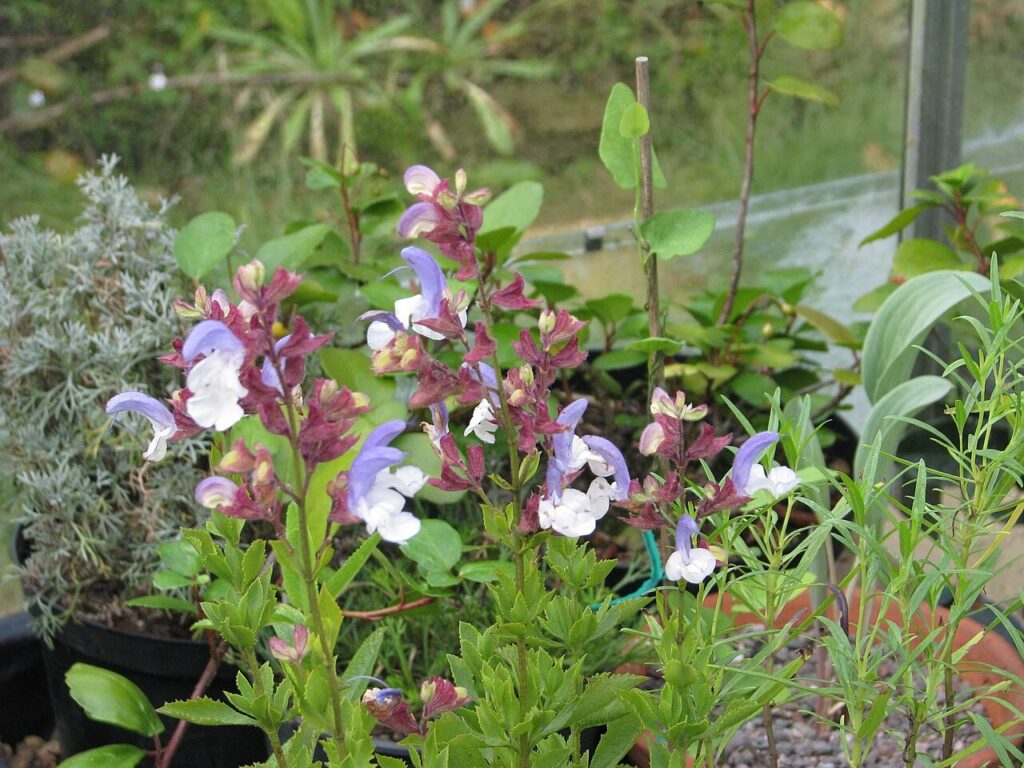
Blue-and-white flowers above aromatic green foliage
Salvia chamelaeagnea is a dense, evergreen shrub that can reach almost 2 m, with many strong, upright, square stems. Its bright green leaves grow opposite one another, are slightly hairy and sometimes toothed, and carry scent-producing glands that make the foliage strongly aromatic and slightly sticky when touched.
From November to May, flowers appear in whorls along the upper third of the stems, opening from the lower branches towards the tips. The corolla may be blue, mauve, pink or white, but the best-known form has a deep-blue upper lip and a white lower lip set against a reddish-purple, glandular calyx.
The broad lower lip provides a landing platform for bees and other insects. As a visitor pushes into the flower for nectar, the sage’s hinged stamens swing down and place pollen on its back; on a later visited flower, the curved stigma is positioned to collect it. Butterflies and other nectar seekers also use the flowers.
This South African endemic belongs to winter-rainfall fynbos of the Northern and Western Cape. It often grows in sandy ground among rocks, particularly beside seepages and riverbeds. After fire it can resprout from its woody rootstock. SANBI assesses it as Least Concern, with a stable population. These ecological traits help explain its usefulness in gardens and appropriately placed restoration plantings.
Individual plants flower for only part of the November-to-May season. Groups can extend the display, while evergreen foliage maintains structure between flowering episodes.
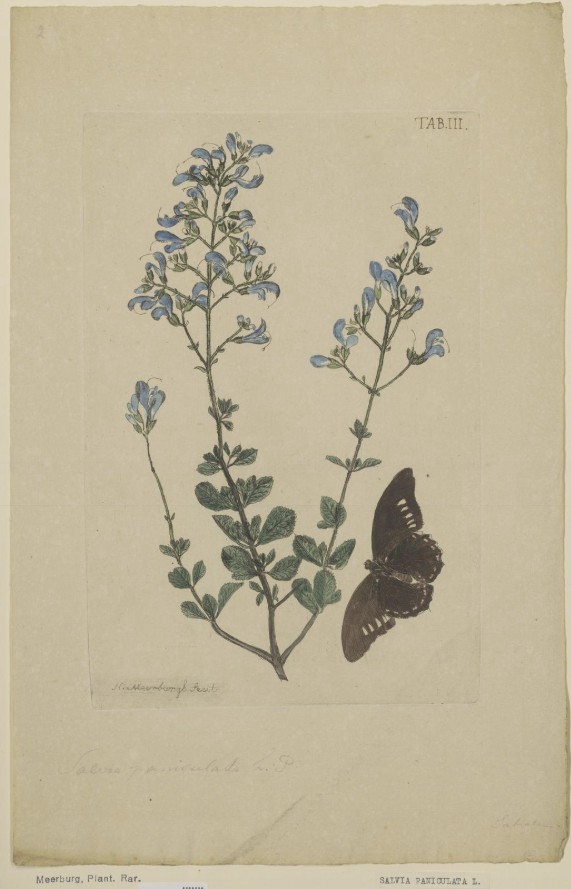
A name with history: Peter Jonas Bergius first published the accepted name Salvia chamelaeagnea in 1767 in his Descriptiones plantarum ex Capite Bonae Spei . Linnaeus published Salvia paniculata in the same year, a name now treated as a synonym. Nicolaas Meerburgh later illustrated the plant under that synonym in plate III of Afbeeldingen van zeldzaame gewassen in 1775, creating the coloured engraving reproduced below.