Salvia aurea
Golden sage · beach sage · dune sage · sand sage · bruinsalie
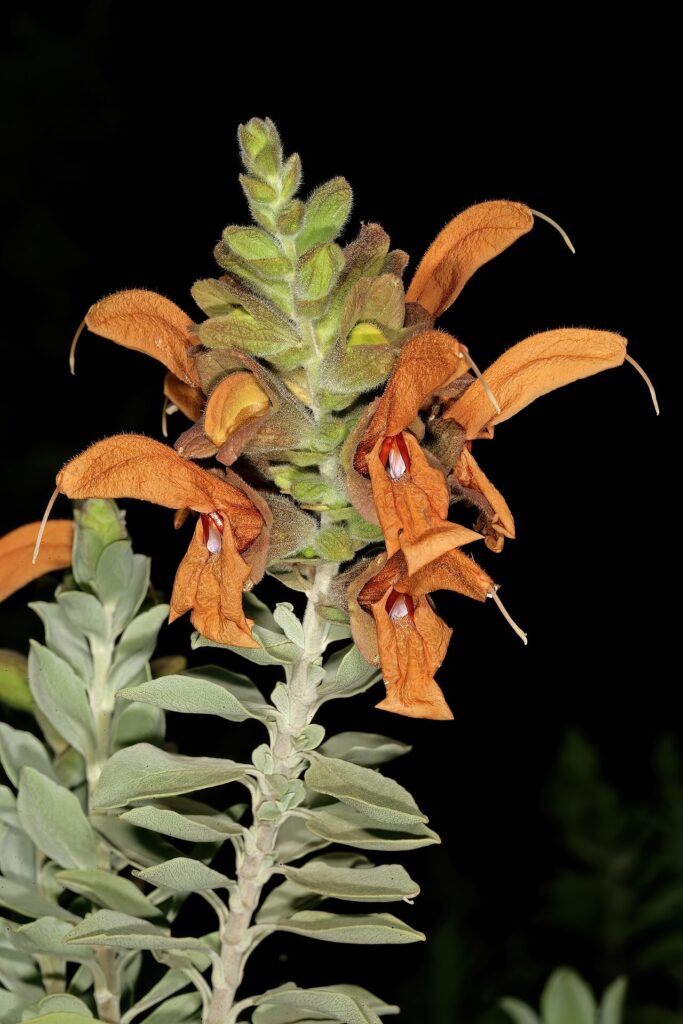
Golden flowers that deepen to burnished brown
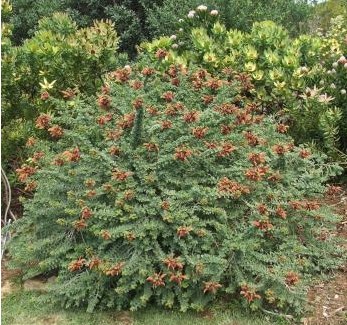
Salvia aurea is a hardy, aromatic and fairly fast-growing evergreen shrub, usually much branched and reaching up to about 2 m. Its grey-green foliage gives the plant a soft, silvery character, while the young stems show the square form typical of the sage family.
Flowering runs mainly from July to January. The unusually coloured flowers open bright yellow, then fade through rusty orange to reddish brown. After the petals fall, the broad saucer-like calyx dries to a papery texture and remains decorative on the stems.
The flowers contain abundant sweet nectar and are visited by bees, moths and sunbirds. Like other sages, each flower has a lever-like stamen mechanism: an insect entering for nectar presses a sterile part of the stamen, causing the anther to swing down and place pollen on its back.
This South African endemic occurs along the coast from Namaqualand to the Cape Peninsula and eastwards to Port Alfred, often as a common component of coastal sand-dune vegetation. SANBI assesses it as Least Concern: it is widespread and is not considered threatened.
A single branch can carry fresh yellow blooms, older rusty flowers and the empty papery cups of earlier flowers at the same time. This changing sequence gives the shrub its distinctive warm palette and makes the calyx as useful for identification as the petals. The aromatic foliage supplies a further identifying clue, and the shrub remains recognisable after its brightest flowering period has ended.
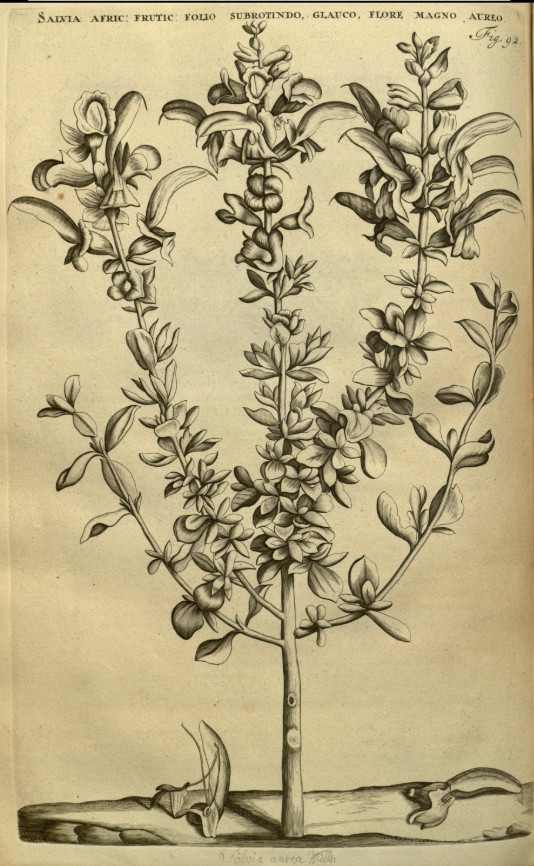
A name with history: The species has a long illustrated and botanical history. It appeared in J. Commelijn’s Horti Medici Amstelodamensis in 1701 as a golden-flowered African sage. Linnaeus used the illegitimate hyphenated name Salvia africana-lutea in 1753, then published the accepted name Salvia aurea in 1762. Its aromatic leaves also have a history of use in Cape household and traditional remedies.