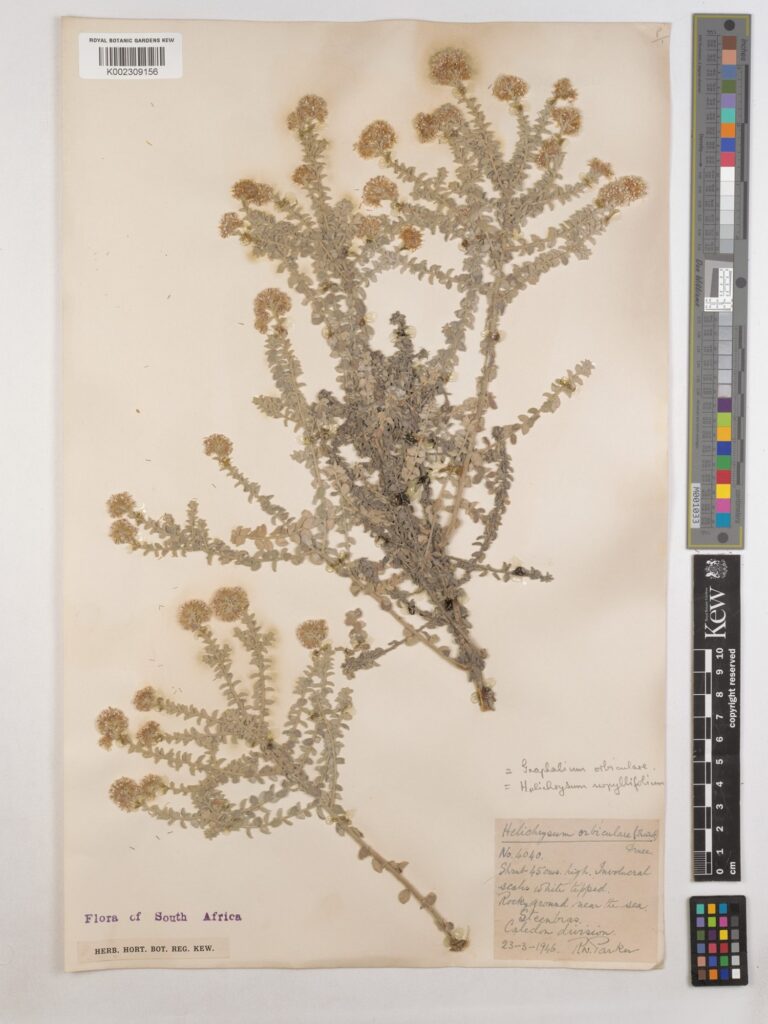
Plecostachys serpyllifolia
Cobwebbush · vaaltee · kooigoed
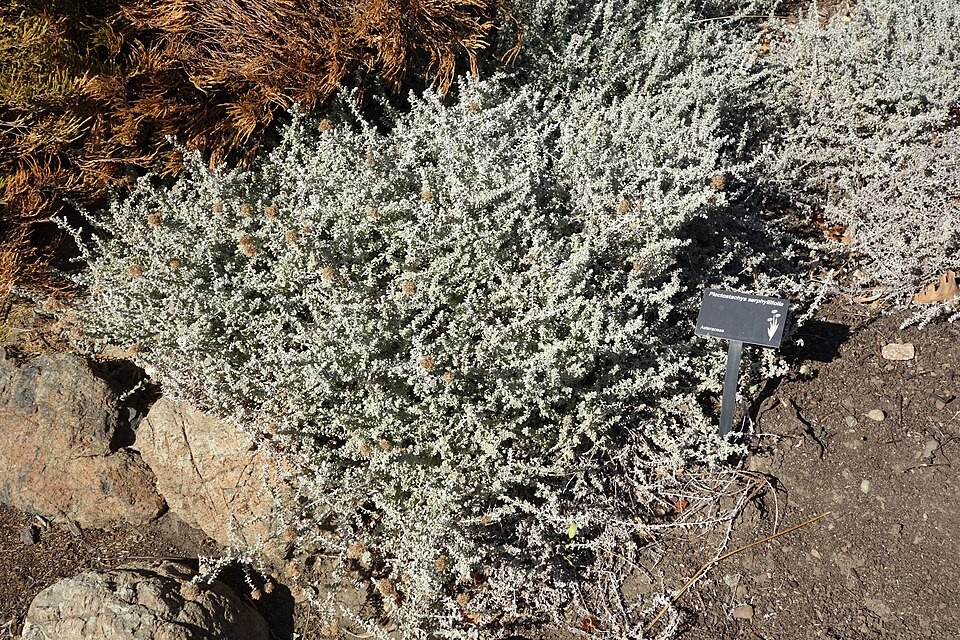
A soft silver tangle of coastal fynbos
Plecostachys serpyllifolia is a much-branched, sprawling perennial shrublet, usually up to about 1 m high. Its long, slender stems weave together into a loose mound. The entire plant appears grey and woolly, with small oval leaves whose downcurved tips and wavy margins add to its soft, cobwebbed texture.
From March to May, peaking in April, many tiny flowerheads crowd into rounded clusters at the tips of the branchlets. The flowers are yellow to brownish, surrounded by small milky-white bracts. The subtle display is best appreciated at close range.
This South African endemic occurs on seasonally damp, sandy coastal flats from the Western Cape through the Eastern Cape to southern KwaZulu-Natal, as well as damp lower mountain slopes. Grey, hairy leaves reflect sunlight, reduce evaporation and protect the stomata, helping the plant withstand coastal wind and summer drought. It is assessed as Least Concern.
Each apparent flower cluster consists of many small heads, not one large daisy. The white bracts and minute central florets can be difficult to separate with the naked eye, making the close-up photograph useful. Outside flowering season, the fine felt on the leaves and the way slender branches thread through surrounding vegetation provide better clues than colour alone.
A name with history: Peter Jonas Bergius first described the species as Gnaphalium serpyllifolium in Descriptiones Plantarum ex Capite Bonae Spei in 1767. Olive Hilliard and Brian Burtt established the small genus Plecostachys and published the present combination in 1981. The name combines Greek words meaning “to twist or plait” and “spike”, referring to its tangled stems and clustered inflorescences; serpyllifolia means “with leaves like wild thyme”. The Afrikaans name kooigoed , or “bedding material”, recalls the traditional use of its soft woolly foliage for sleeping on.