Leucadendron xanthoconus
Sickle-leaf conebush · blinkblaartolbos · geelbos
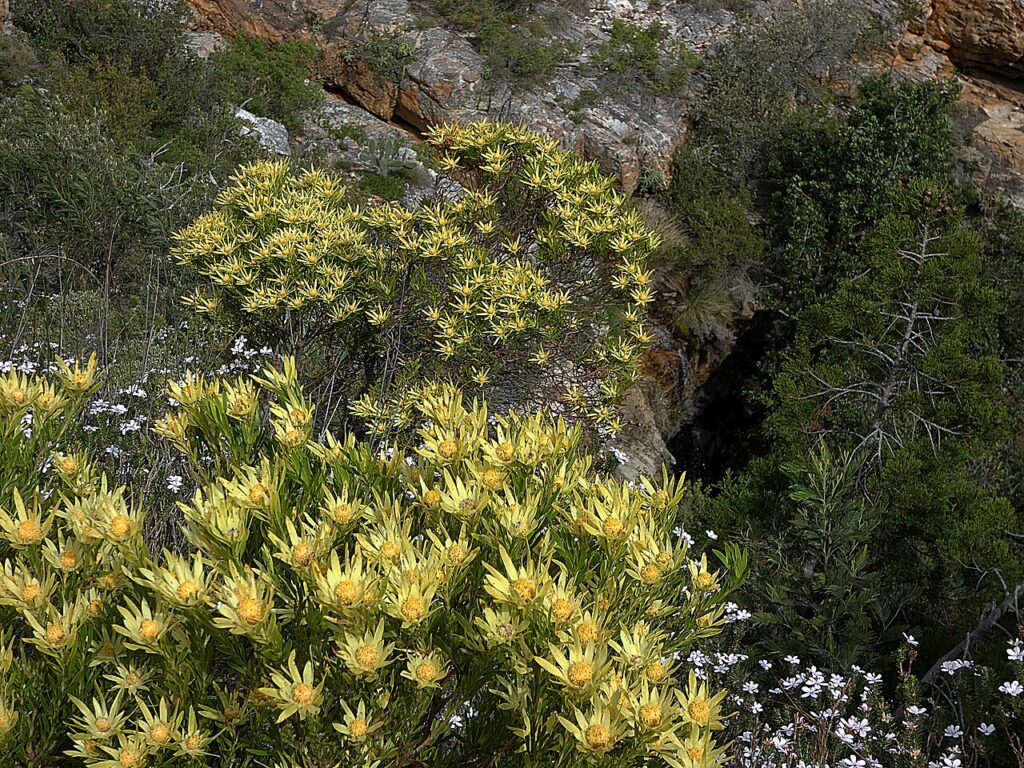
Golden flowerheads that light up the spring fynbos
Leucadendron xanthoconus forms a dense evergreen shrub, usually reaching about 1–2 m. A single main stem supports upright branches with narrow, slightly curved leaves. Fine silvery hairs give young foliage a distinctive sheen; older leaves become smoother. Together, the curved shape and shining tips help distinguish it from several similar conebushes.
In August, sometimes extending into September, the leaves surrounding the flowerheads turn yellow-green. These colourful floral leaves create the golden patches seen across fynbos hillsides. Male and female flowers grow on separate shrubs. Male heads are especially conspicuous, while female heads develop into woody, hairy cones that retain their seeds for several years. Even outside flowering, the fine-textured foliage adds a soft silvery contrast to darker neighbouring shrubs.
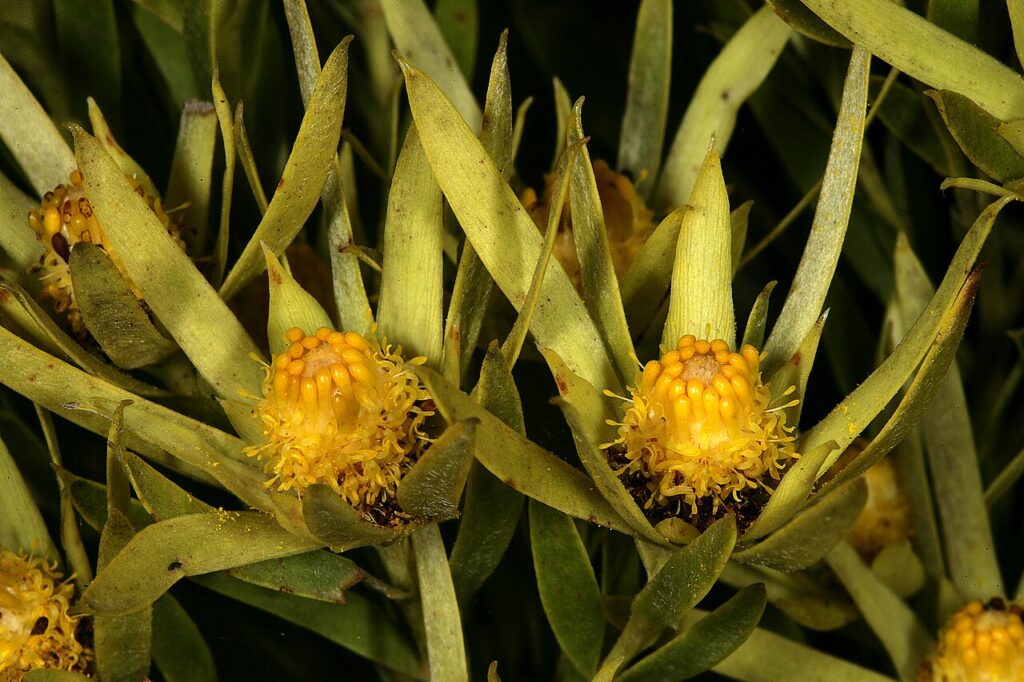
Insects transfer pollen between the sexes, so a mixed group supports both pollination and a future seed crop. The true flowers are much smaller than the colourful display suggests. Looking closely at the central head reveals the flowers themselves, framed by the brighter surrounding leaves.
This species regenerates from seed after fire. Adults are killed, but the cones store winged seeds above ground until the disturbance releases them. Wind spreads the seeds into the opened landscape, and winter conditions favour the next generation. Repeated fires before young shrubs produce cones can interrupt this cycle.
Its range extends from the Cape Peninsula to Potberg in the Western Cape. Dense populations remain in protected landscapes, and SANBI assesses it as Least Concern. Continued control of invasive alien plants helps maintain those populations and the open fynbos on which they depend.
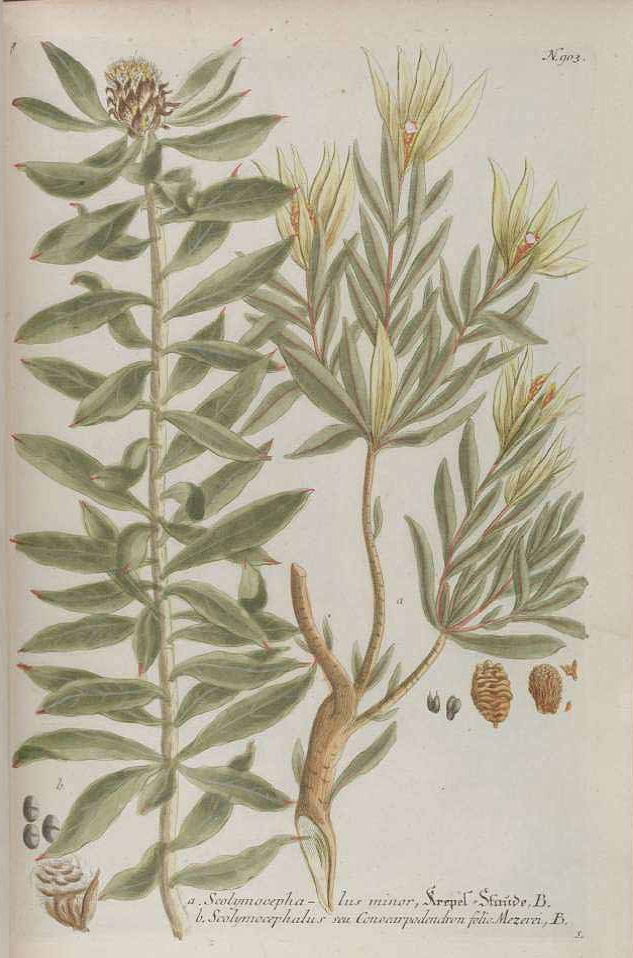
A name with history: Xanthoconus means ‘yellow cone’, describing its bright flowerheads. Older botanists included some material under Leucadendron salignum, although the two are distinct. The eighteenth-century Weinmann plate below is catalogued for this species, with the relevant plant identified as figure a.