
Leonotis leonurus
Wild dagga · lion’s ear · lion’s tail
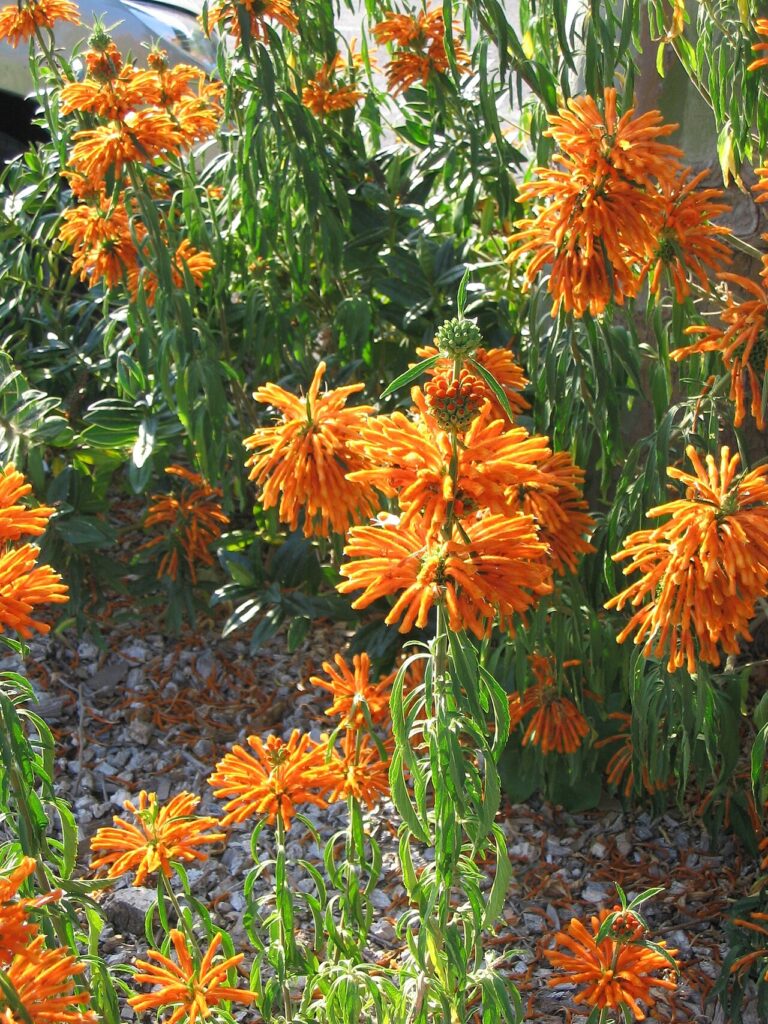
Tiered orange flowers that turn a shrub into a sunbird tower
Leonotis leonurus is a fast-growing, soft-wooded shrub, commonly reaching 2–3 m tall and about 1.5 m wide. Erect, branching stems rise from a woody base and are square in cross-section. Its narrow, toothed leaves feel rough above and softly hairy beneath, releasing a strong herbal scent when crushed.
The flowers form rounded whorls spaced along the stems, creating unmistakable tiers of orange. Each velvety tube emerges from a pointed calyx that protects the developing buds and later the seeds. The hooded upper lip is hairy; the smaller lower lip curves back. Orange is familiar, but white, yellow and apricot garden forms also occur.
In Cape Town the main display is usually March–June, with a smaller spring flush. Flowering seasons differ elsewhere in South Africa, so an autumn display here need not contradict reports of summer flowering in other regions. The long bloom period makes it particularly useful when assembling a garden with nectar available across the seasons.
Sunbirds are important pollinators. Their long bills reach nectar inside the tubes, while bees and butterflies also visit. Once flowering finishes, the dry heads retain a strong architectural outline. Allowing some seed to mature before pruning preserves another stage of interest and provides material for propagation.
The species is widespread in South Africa, growing among rocks, in grassland and along forest margins. Locally, records support strandveld scrub and sandstone slopes. It is assessed as Least Concern. Although established plants tolerate drought, their brittle stems can snap in exposed positions, an important consideration in the Park’s strong south-easter.
A name with history: Linnaeus described it as Phlomis leonurus in 1753; Robert Brown published Leonotis leonurus in 1811. Leonotis means “lion’s ear”. Edwards’s 1800 illustration below beautifully records the distinctive flower tiers under the earlier name.

