Isolepis prolifera
Vleigras · incapha · proliferating club-rush

A stream-edge sedge that grows new plants from its flowerheads
Isolepis prolifera is a perennial sedge of freshwater streams, marshes and seepage areas. Its smooth green stems grow in tufts, commonly 20–60 cm tall, sometimes reaching about 90 cm. They may stand upright or arch loosely over the water. True leaf blades are absent or greatly reduced; reddish basal sheaths surround the stems.
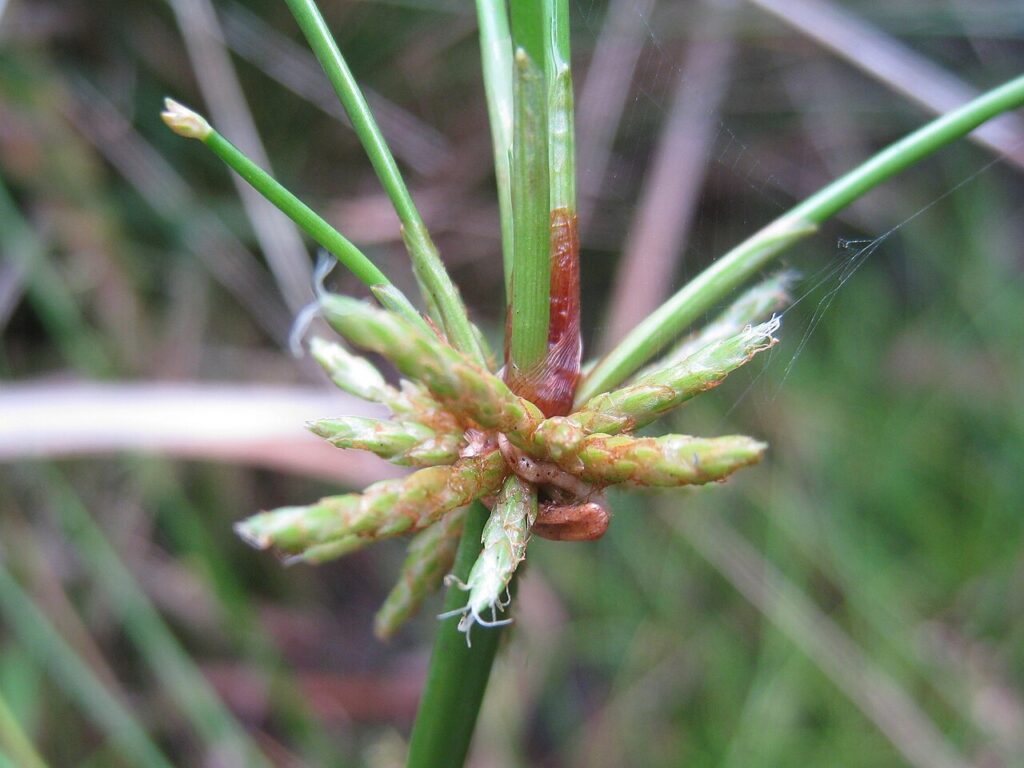
Small flower clusters appear near the stem tips, slightly to one side. Each contains narrow spikelets coloured green to light reddish brown. The tiny flowers lack showy petals, so the plant’s appeal lies in its texture, branching outlines and foliage. Viewed closely, a seemingly simple tuft reveals a surprisingly intricate structure.
The flowerheads often produce shoots that carry further clusters. As stems bend down, these growths can take root in wet ground, expanding the patch without depending entirely on seed. This habit gives the plant its English name, budding club-rush. Its small nutlets also provide another means of reproduction and may travel in water.
Local herbarium records provide a local connection: Wolley-Dod collected it at Muizenberg Vley in 1896, and Pillans at Marsh Stream on the Muizenberg Plateau in 1918. These records link it to both lowland wetlands and watercourses through sandstone fynbos. Within either landscape, reliable freshwater moisture matters more than the surrounding dryland vegetation.
The species is indigenous to South Africa, with records in the Western Cape, Eastern Cape and KwaZulu-Natal, and is assessed as Least Concern. Its natural range also includes Australia, New Zealand and southern Atlantic islands. In garden ponds it can spread vigorously, so maintaining openings between clumps helps preserve a varied waterside planting.
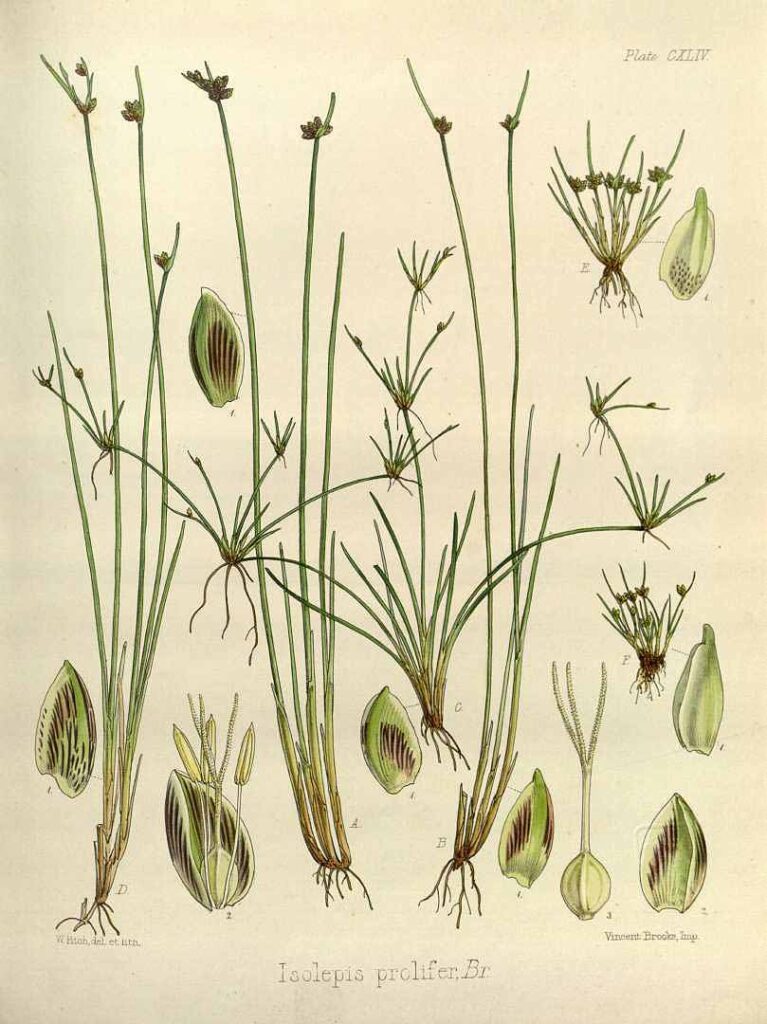
A name with history: Isolepis means “equal scales”, referring to the spikelet coverings; prolifera means proliferating. Rottbøll described it as Scirpus prolifer in 1773. Robert Brown published the present combination in 1810. Fitch’s 1860 illustration below records its branching habit.