Helichrysum pandurifolium
Fiddle everlasting · fiddle-leaved strawflower · kooigoed

A silver-grey everlasting with fiddle-shaped leaves
Helichrysum pandurifolium is a spreading evergreen shrub, usually reaching about 1 m tall. Numerous soft, loosely branched stems carry a covering of grey woolly hairs. Its long, slender branches give the plant a relaxed outline, contrasting with the more rigid shapes of many fynbos shrubs.
The small leaves are felted on both sides, with conspicuously crinkled margins. Each rounded or oval blade narrows abruptly towards an eared base that clasps the stem. This distinctive silhouette explains the common name “fiddle everlasting” and is worth examining closely along the Park’s path.
From September to January, especially October to December, loose clusters of bell-shaped flowerheads appear at the branch tips. Yellow florets are enclosed by several rows of creamy white, papery bracts, sometimes flushed with pink. These pointed bracts retain their shape after flowering, giving the heads their everlasting character.
The species ranges from the Cape Peninsula through coastal and mountain districts to the Tsitsikamma and Kouga Mountains. It grows on sandy or rocky hillsides, from near sea level to high slopes. Locally, SANBI records it in sandstone fynbos on Constantiaberg. It is South African endemic and assessed as Least Concern.
Bees and other insects visit the flowers. The small fruits carry bristly hairs that aid wind dispersal, while the woolly foliage helps reduce moisture loss. The plant’s strong aroma and traditional herbal uses add another dimension to a planting enjoyed for both scent and texture. For identification, compare both leaf shape and the pointed bracts; scent alone cannot reliably separate similar everlastings.
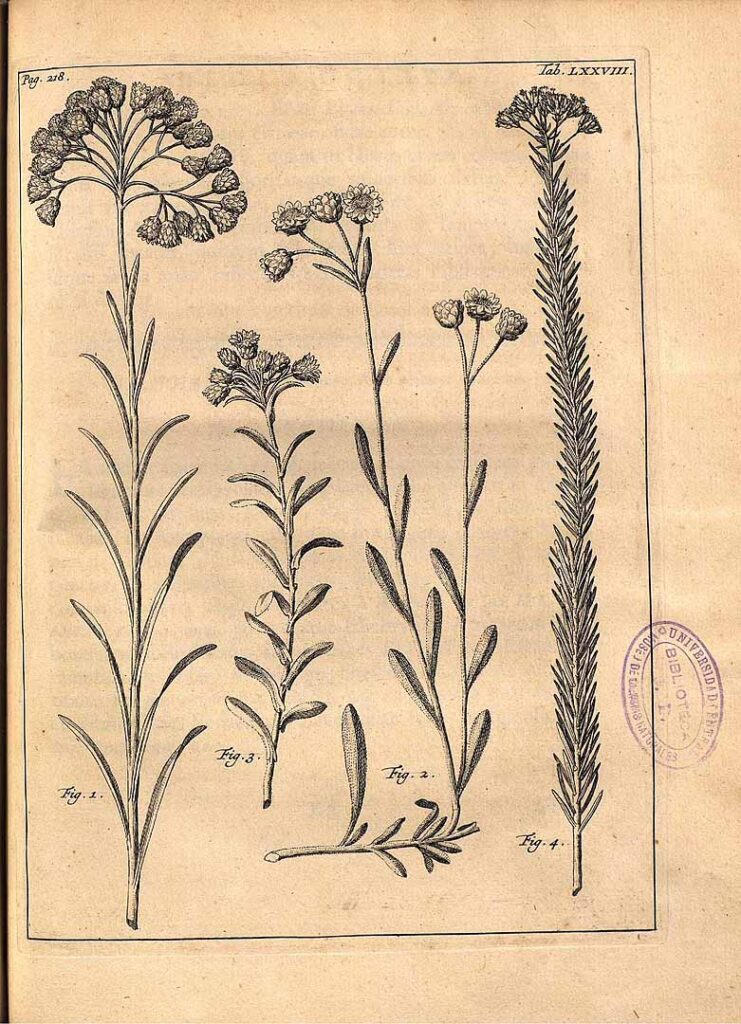
A name with history: Helichrysum combines Greek words for sun and gold; pandurifolium means “fiddle-leaved”. Franz von Paula Schrank published the name in 1824. The engraving below predates it: figure 3, at centre-left of Johannes Burman’s 1739 plate 78, is identified with this species. The complete plate also shows three other plants, preserving its original botanical context.