Helichrysum cymosum
Gold carpet · goue tapyt · impepho

A silver carpet lit with golden flowerheads
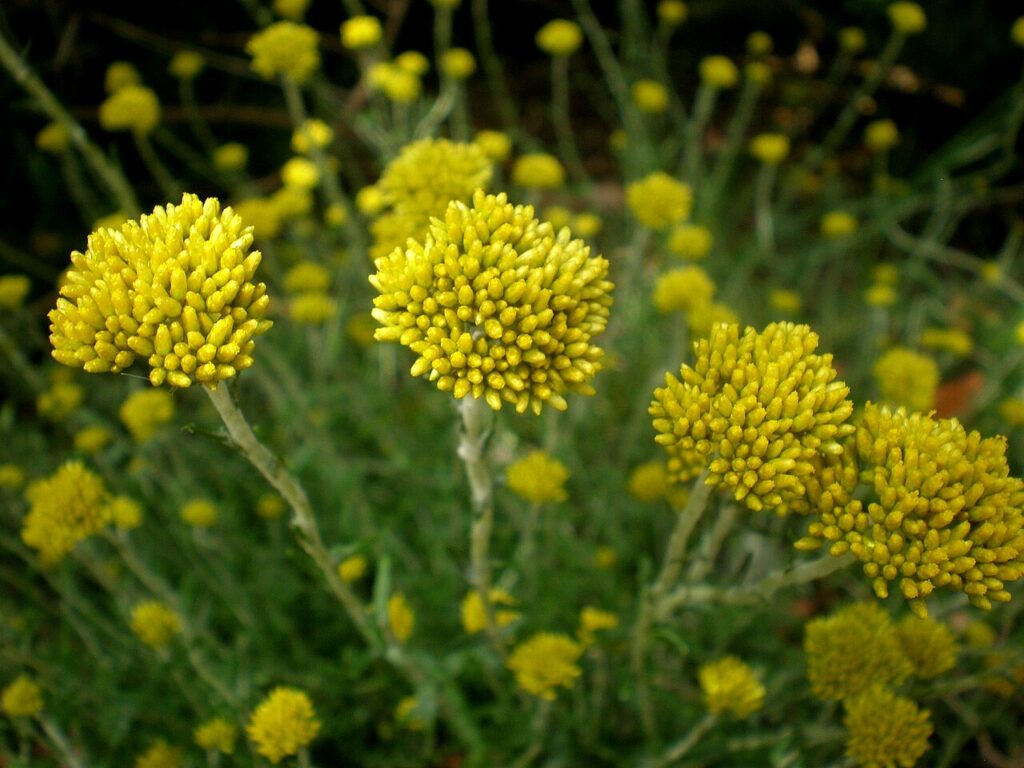
Helichrysum cymosum subsp. cymosum is a fast-growing, evergreen groundcover that forms broad, straggling clumps. It can reach about 1 m, although garden plants are more often around 50 cm high. Thin, grey-white woolly branches carry aromatic leaves with silvery, paper-like hairs.
From September to April—most strongly in late summer and autumn—the foliage is covered by flat-topped sprays of bright canary-yellow flowerheads. Each apparent “flower” is actually a compact head containing several minute florets, surrounded by glossy bracts that retain their colour and papery texture as they dry.
The pale foliage reflects light and helps reduce moisture loss, while the spreading stems shelter the soil. It tolerates salty air and sandy ground. Although SANBI describes it as hardy in dry gardens, local Cape Town nursery experience stresses that the low-growing coastal form thrives in damp spots. Its occurrence in moist dune hollows, Cape scrub and forest margins helps explain that preference: silvery leaves alone are not evidence that a plant needs little water.
Its natural range extends from the Cape Peninsula eastwards along the coastal mountains and through the Eastern Cape to northern KwaZulu-Natal. The coastal subspecies is common and assessed as Least Concern. Its flowers support small insects, while the dense growth provides low cover close to the ground.
There are two recognised subspecies. This page concerns the coastal subsp. cymosum; subsp. calvum occurs mainly in grassland farther inland. The coastal form has a tuft of bristles, called a pappus, associated with its tiny fruits. The grassland form lacks that pappus and generally has fewer florets in each head. These small details are more dependable identification clues than colour alone.
A closer look at the flower sprays reveals several levels of branching: a broad cluster is made up of many little heads, and each head contains individual tubular florets. Unlike a familiar daisy with conspicuous ray petals, the display is made by these clustered yellow heads. Bees visit the flowers, making a patch useful both as a foliage groundcover and as seasonal insect forage.
Its habit varies with growing conditions, from a low mat to a loose shrub. Allowing that variation makes restoration planting more natural: select locally propagated material appropriate to the moisture and exposure of the planting site. A plant from a damp dune hollow may perform differently from one raised for a dry ornamental border, even when both carry the same species name.
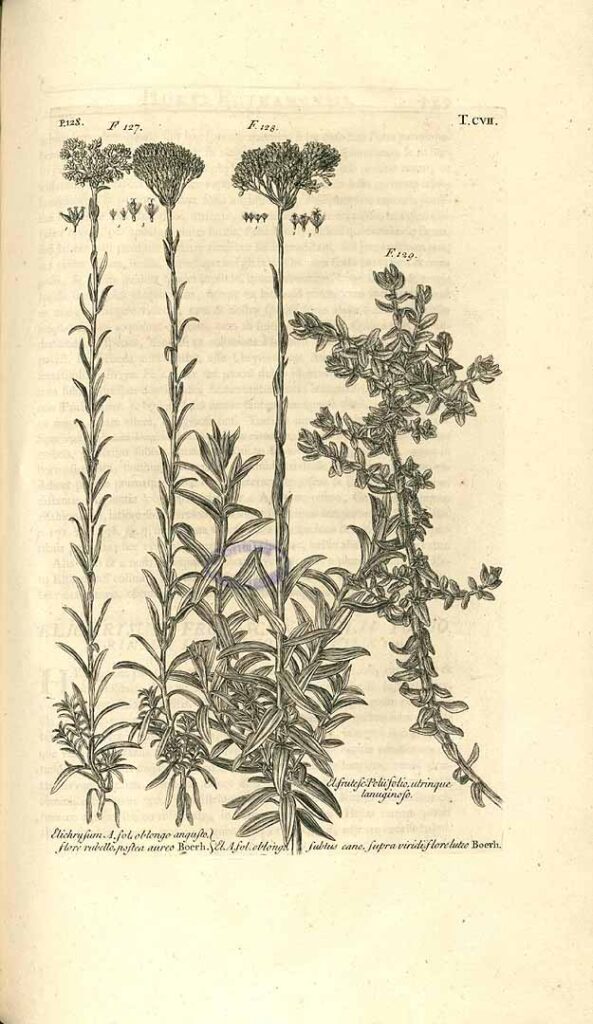
A name with history: Helichrysum comes from the Greek words for sun and gold. Cymosum refers to its branching cymes, the flat-topped flower clusters. Linnaeus published Gnaphalium cymosum in 1753; the combination Helichrysum cymosum appeared in 1830. The Afrikaans name goue tapyt means “gold carpet”, while impepho reflects a broader cultural tradition associated with aromatic helichrysums. The engraving below predates that name: it is plate 107 of J. J. Dillenius’s Hortus Elthamensis (1732). Linnaeus cited its central figure 128 in his 1753 description of Gnaphalium cymosum. The drawing shows the branching plant, narrow leaves and clustered heads, with small floral details beside the main stem. Figures 127 and 129 are other plants; the complete plate preserves that original botanical context.