Geranium incanum
Carpet geranium · wild geranium · bergtee
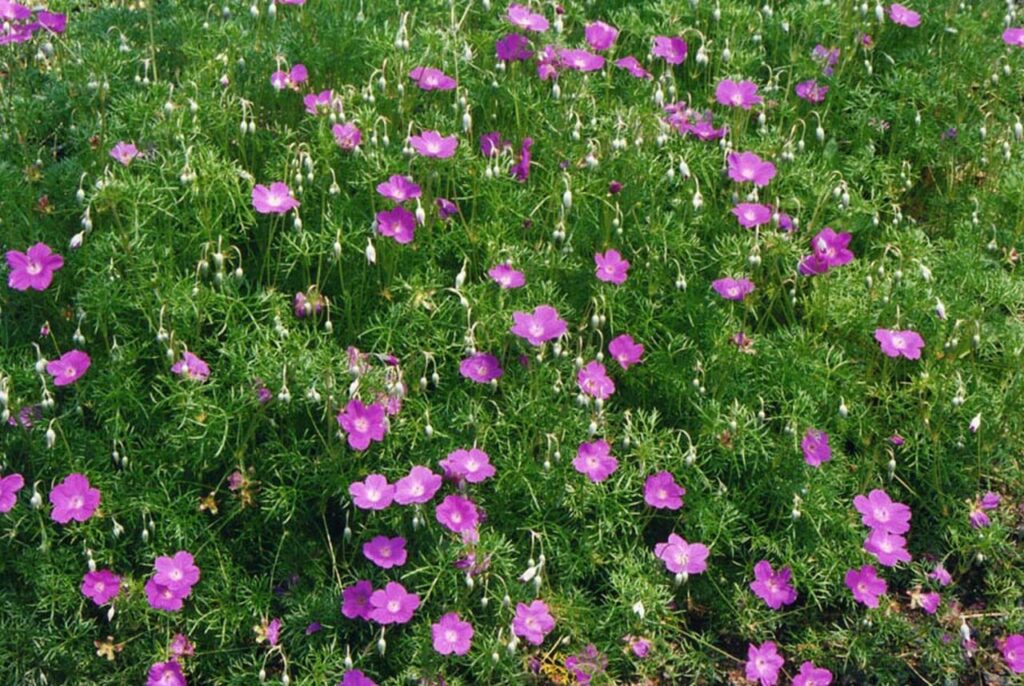
A soft silver carpet scattered with mauve
Geranium incanum is a low, much-branched perennial that spreads into a softly textured carpet about 100–300 mm high. Its leaves are deeply and delicately divided, giving them an almost fern-like appearance. They are green above and paler or greyish beneath—the feature recalled by the Latin incanum, meaning hoary or grey-white.
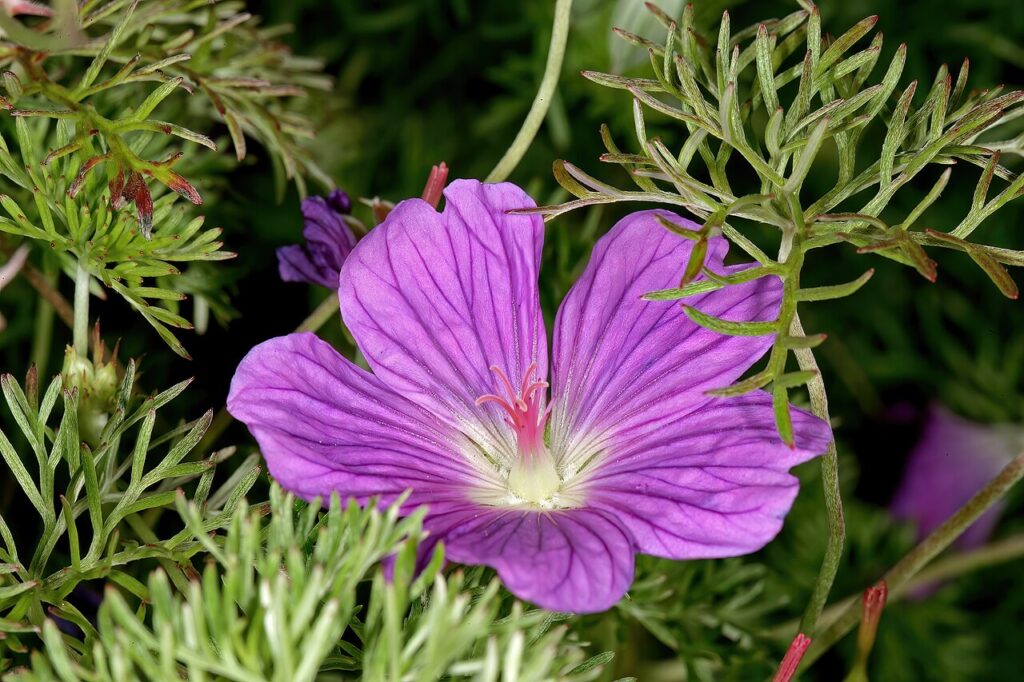
The five-petalled flowers range from pale mauve to violet-pink, often with fine darker veins that guide visiting insects towards the centre. Plants may flower through much of the year, with their strongest display in spring and summer. Full sun generally produces a tighter carpet and more abundant flowers, although light shade is tolerated.
After pollination, the fruit develops the long pointed “beak” characteristic of true geraniums. The genus name comes from the Greek geranos, meaning crane, because the fruit resembles a crane’s bill. As it ripens, the fruit separates into springy sections that help scatter the seeds.
The species is native to southern Africa, occurring naturally in the Cape Provinces, Free State, KwaZulu-Natal and Lesotho. Its scrambling habit allows it to weave through neighbouring vegetation, and its perennial base allows growth to continue over more than one season. Local forms benefit from reliable moisture: their fine foliage should not be mistaken for proof of prolonged drought tolerance. SANBI assesses the Cape varieties as Least Concern.
The upper surface of a leaf and its pale underside offer different clues. Narrow segments give the foliage its lacy appearance, while the hairs beneath contribute to its silvery effect. A close view also reveals the contrast between the slender leaf divisions and the broad, veined petals. These details explain why it works so well as a soft-textured companion to restios and woody shrubs.
It is a true Geranium, with five broadly similar petals arranged around the centre. Most bedding plants sold as “geraniums” belong to Pelargonium, a related genus whose flowers are usually less symmetrical. Flower shape, leaf detail and the developing fruit together are more useful than the common name alone.
In Cape Town, local nursery observations particularly associate it with seasonal wetland margins within strandveld. SANBI also records it in sunny, well-drained sandy fynbos on Table Mountain Sandstone. The habitat box therefore includes both lowland wetland edges and the sandstone association; moisture and an open position help explain its presence across these different settings. Wetland margins here mean the surrounding ground, rather than deep standing water.
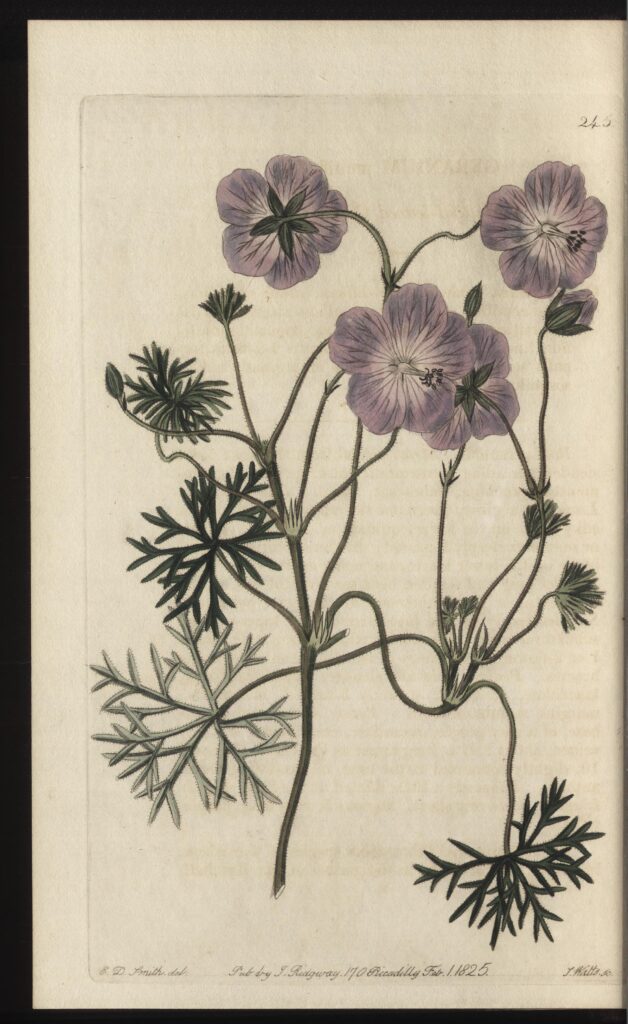
A name with history: Nicolaas Laurens Burman published Geranium incanum in Specimen Botanicum de Geraniis in 1759. The Afrikaans names bergtee and vrouetee preserve its cultural association with herbal tea. The historical illustration below is plate 245 from Robert Sweet’s Geraniaceae, drawn by E. D. Smith and dated 1 February 1825. It appeared under the name Geranium multifidum, now treated by Kew as a synonym of G. incanum subsp. incanum. The finely cut leaves and mauve, veined flowers make the connection with the living photographs especially clear.