Fuirena coerulescens
Blue umbrella-sedge
A leafy sedge built for shifting water
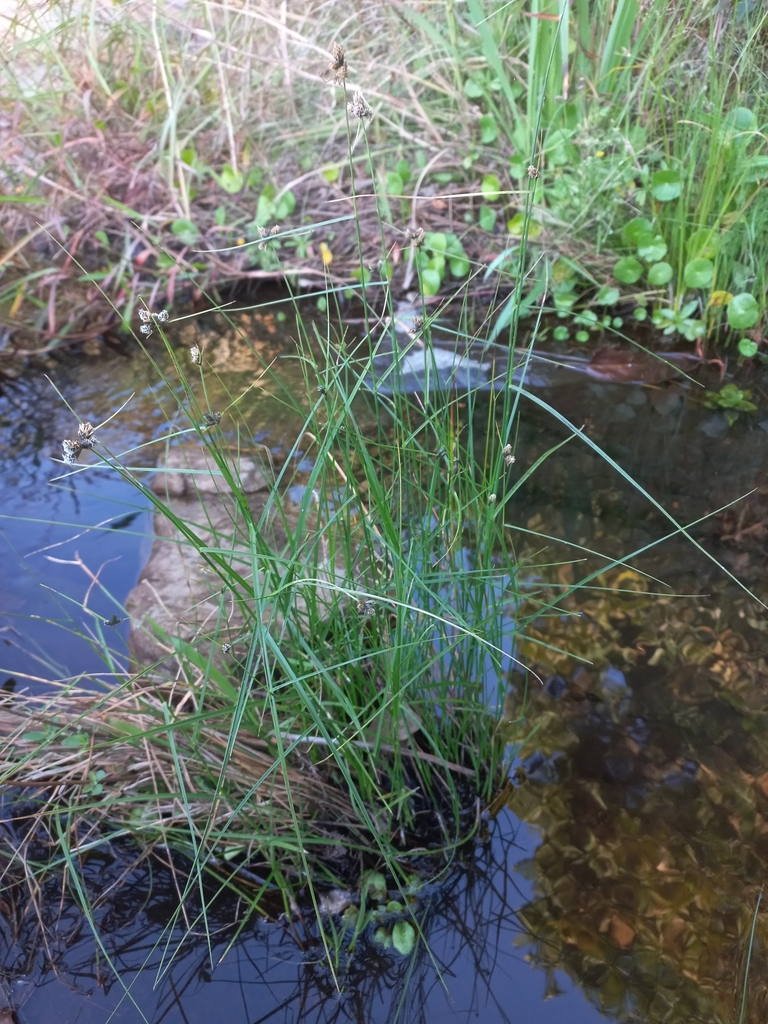
Fuirena coerulescens is an upright, rhizome-forming perennial sedge of marshes, wet grassland, seeps and stream margins. Its creeping underground stems produce leafy shoots that can gradually form a colony. The Cape flora describes plants 20–40 cm tall on marshy flats and lower slopes, although the species is variable and taller plants occur elsewhere in its range.
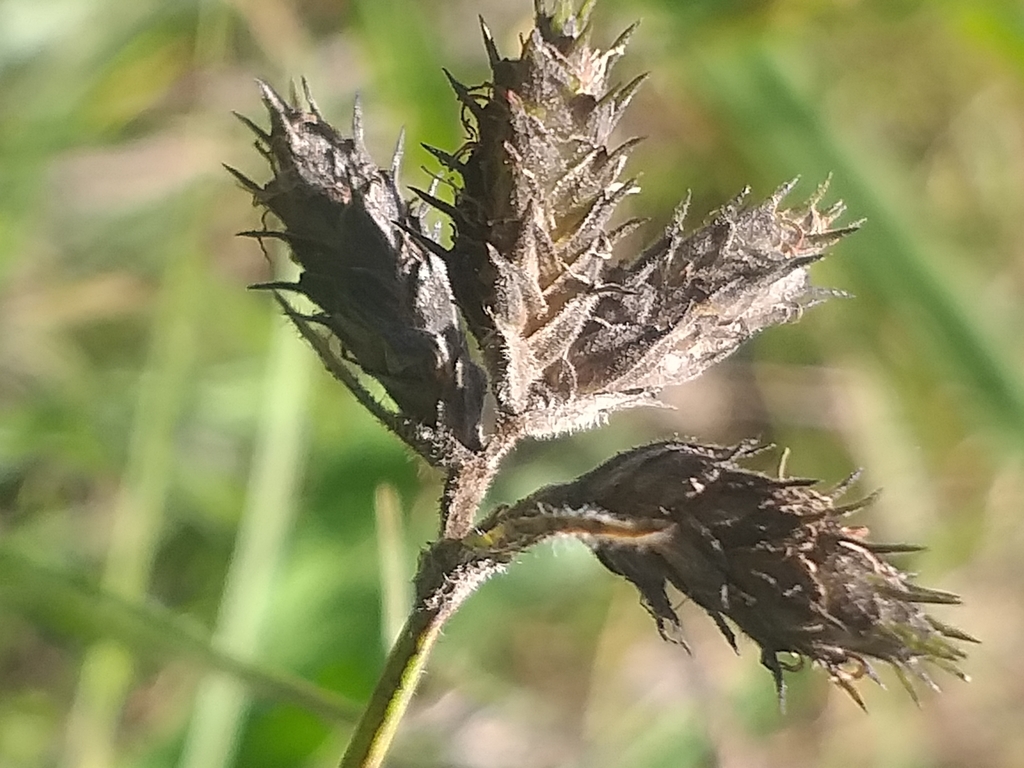
Unlike the almost leafless club-rushes, it carries flat, grass-like leaves on visibly jointed, sharply triangular stems. Clusters of spikelets gather towards the shoot tips. Young heads can have a bluish-green cast, becoming browner as they mature. Their overlapping glumes have projecting points, giving a close-up of the cluster a distinctly bristly appearance.
For the Cape, the published flowering period is September to March. The flowers are small and lack the colourful petals of most garden plants. Under magnification, bristle- and scale-like floral parts surround the developing nutlet. These minute structures are important in identification, so the overall colour and outline of a plant are useful clues rather than a complete diagnosis.
Its rhizomes allow neighbouring shoots to occupy damp ground together. In the Park, look along the stream and in winter-wet hollows, where moisture remains longer than on the surrounding slopes. The habitat box highlights Cape Lowland Freshwater Wetlands: a wet pocket within a wider landscape should not automatically be described as typical dry sandstone fynbos, granite fynbos or strandveld habitat.
A 2006 ecological survey of the greater Zandvlei area recorded two nearly pure patches of this species. The study cautioned that expanding single-species patches could reduce the diversity of a wetland mosaic. This is a useful local reminder that an indigenous plant can be valuable in its natural setting while still requiring space and thoughtful management in a small planted area.
The species occurs from parts of tropical southern Africa southwards to South Africa, and also in Madagascar. It is indigenous rather than endemic to the Cape, and South Africa’s Red List assesses it as Least Concern. Preserving its local habitat still matters: drainage and changes to water flow can remove the damp conditions on which a wetland plant depends.
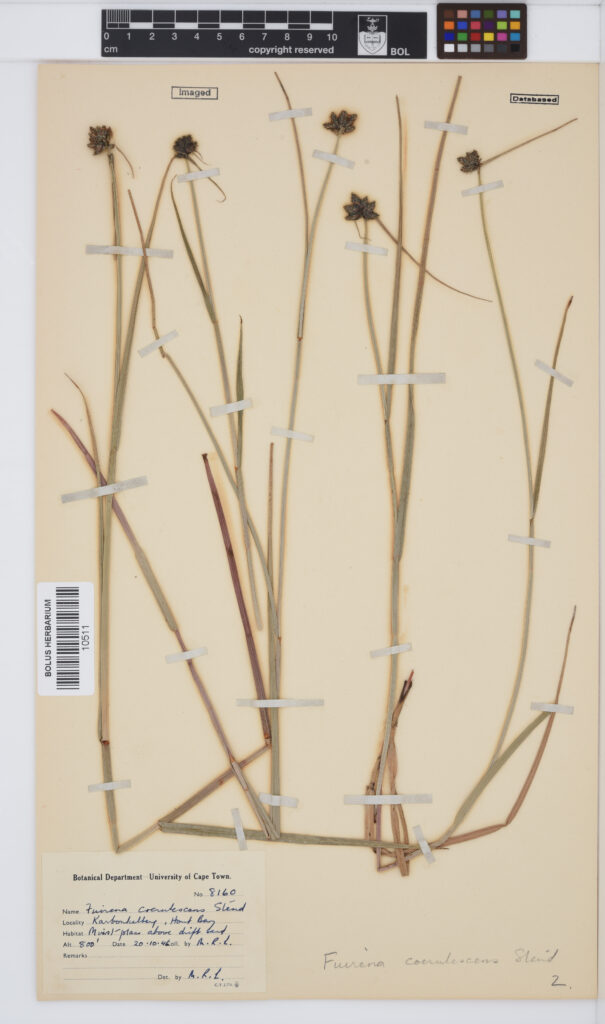
A name with history: Ernst Gottlieb von Steudel published the name in 1829. Fuirena honours Danish botanist Georg Fuiren; coerulescens means “becoming bluish”, consistent with the blue-green appearance described in the Cape flora. Patricia L. Forbes’s 1997 review united several previously separate names under this variable species, including Fuirena enodis and F. reticulata. The historical sheet below was collected by M. R. Levyns at Karbonkelberg, Hout Bay, on 20 October 1946. Its label notes a moist place above drift sand—a direct glimpse of the plant’s Peninsula habitat.