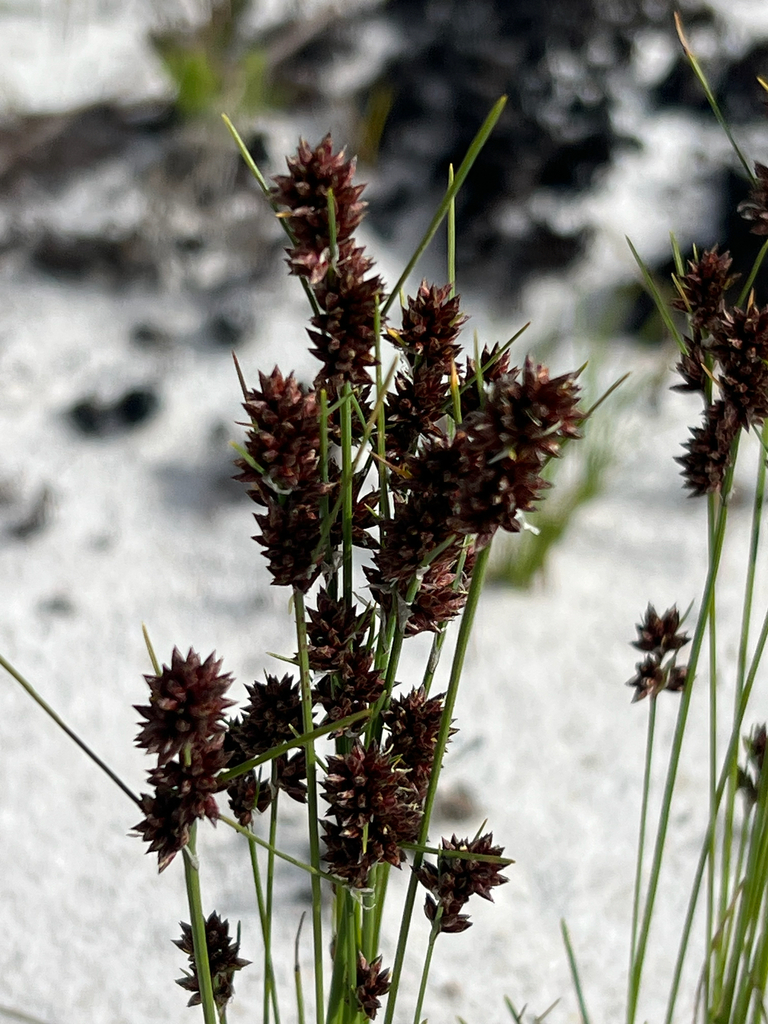
Ficinia bulbosa
Bulbous sedge

A small sedge with a strong Cape identity
Ficinia bulbosa is a compact, tuft-forming perennial, usually 10–35 cm high. It produces narrow green leaves and upright flowering stems from a persistent underground base. The species may also spread by short horizontal stems, allowing several tight tufts to grow together.
Its flowers do not have colourful petals. Instead, many tiny, wind-pollinated flowers are packed into chestnut-brown spikelets at the tips of the stems. These subtle heads are at their best from about February to September. Look also for the conspicuous white, papery edges of the leaf sheaths near the base—an unexpectedly delicate detail on this tough plant.
Sedges can resemble grasses, but their stems are commonly solid and triangular rather than hollow and round. Members of Ficinia have an additional clue: a small collar-like structure, called a gynophore, remains beneath the mature nutlet. This tiny feature is extremely useful to botanists identifying the genus.
A sedge is not automatically a wetland plant. This species belongs as much to open, sandy fynbos as to the coastal landscape, and its modest size allows it to occupy spaces between larger shrubs. The narrow leaves and brown heads reward a close look rather than a distant glance: its contribution is fine texture and the detail of a natural Cape plant community.
The bulbous sedge grows on sandy flats and slopes below about 1,000 m, in strandveld and both coastal and mountain fynbos. It occurs from the Cederberg through the Western Cape into the Eastern Cape and is a South African endemic. The national Red List assesses it as Least Concern, with a stable population.
A name with history: Linnaeus first described the plant as Schoenus bulbosus in 1771. Christian Gottfried Daniel Nees von Esenbeck transferred it to Ficinia in 1833, giving the species its present scientific name. The epithet bulbosa refers to its swollen, bulb-like base. The historical sheet below was collected by N.S. Pillans on Table Mountain on 2 June 1918 (collector number 3827; Bolus Herbarium BOL 8989). Its label describes the plant as locally common on the middle northern slopes, providing a tangible link to early Cape botanical fieldwork.