Bolboschoenus maritimus
Alkali bulrush · sea club-rush · snygras

A golden-topped wetland builder
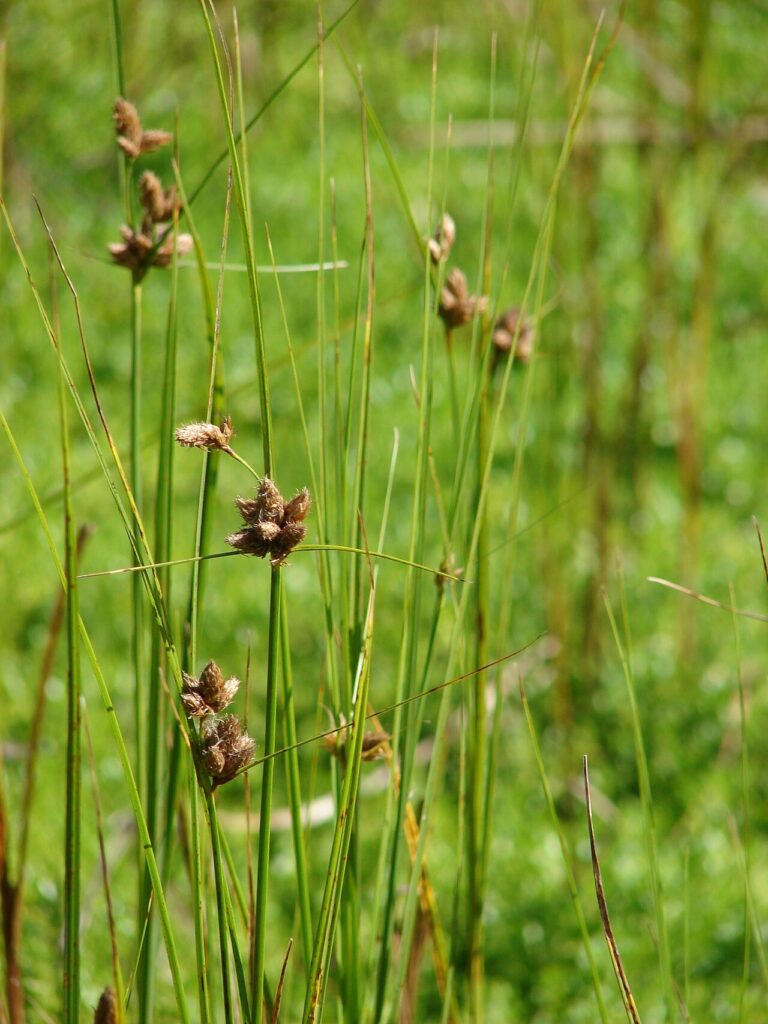
Bolboschoenus maritimus is a perennial sedge, usually 25 cm to 1.2 m tall but occasionally taller. Its smooth stems are distinctly triangular, while its flat, emerald-green leaves have finely serrated edges that can feel sharp.
The plant spreads underground. Each shoot grows from a small corm or tuber and sends out a horizontal rhizome, from which the next shoot emerges. In this way it can rapidly form dense stands that shelter small wetland animals, bind soft mud and slow water movement.
From October to March, flower stems rise above the leaves and carry clusters of golden-brown, egg-shaped spikelets. The flowers are tiny and wind-pollinated; later they produce brown, tear-shaped fruits, each containing a single seed.
This adaptable species occurs across much of the temperate and subtropical world. In South Africa it is found from the Cape Peninsula northwards, chiefly below 700 m, in seasonal and permanent wetlands, pond margins, marshy flats and brackish estuaries. It tolerates conditions that are too wet—or too salty—for many garden plants.
The stand is more than a backdrop for the pond: waterbirds can eat its seeds and underground parts, while its leaves offer nesting material and cover. Seeds may float to a new shore or travel with birds. The plant can persist through seasonal drying because its buried corms and rhizomes rest until the water returns.
Leafy stands broaden during wet periods and become less conspicuous as a seasonal marsh dries. The buried storage organs make that cycle possible. In restoration, leaving room for this expansion allows the sedge to contribute structure without crowding every part of a small pond.
A name with history: Carl Linnaeus described it in 1753 as Scirpus maritimus . Eduard Palla later placed it in Bolboschoenus in 1905. The modern genus name combines Greek words referring to a bulb-like base and a rush.