Otholobium bracteolatum
Strand dottypea · swawelbos · formerly Psoralea bracteolata
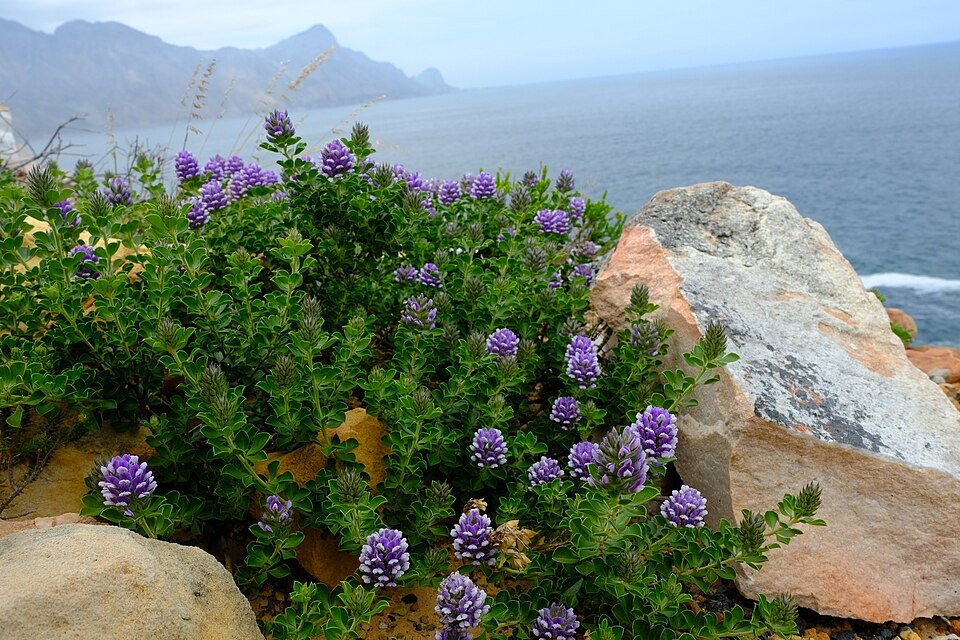
A coastal pea with rounded mauve flowerheads
Otholobium bracteolatum — formerly known as Psoralea bracteolata — is a sprawling, much-branched shrub that can reach about 2 m. Its leaves have three wedge-shaped, gland-dotted leaflets; the young foliage is covered in closely pressed hairs that help protect it from drying coastal winds.
Between November and April, compact rounded flowerheads appear in blue, violet and white. Each pea-like flower is about 8–10 mm long and held in a softly hairy, glandular calyx. The colourful clusters attract Cape honey bees, which carry pollen between flowers.
This South African endemic grows in moist places from Saldanha and Cape Town eastwards to Grahamstown, mostly below 170 m in coastal sandveld, on plains and on limestone hills. It resprouts after fire, develops an extensive root system and tolerates drought and wind, making it valuable for stabilising and rehabilitating disturbed coastal sands. SANBI assesses it as Least Concern.
Its compact flowerheads give a different effect from the scattered blooms of some other Cape pea shrubs. Examine a single leaf to see that it comprises three separate leaflets, then look for the small glands that mark their surfaces. Together, the leafy, spreading framework and clustered summer flowers help distinguish it from the fine-leaved upright fountain bushes.
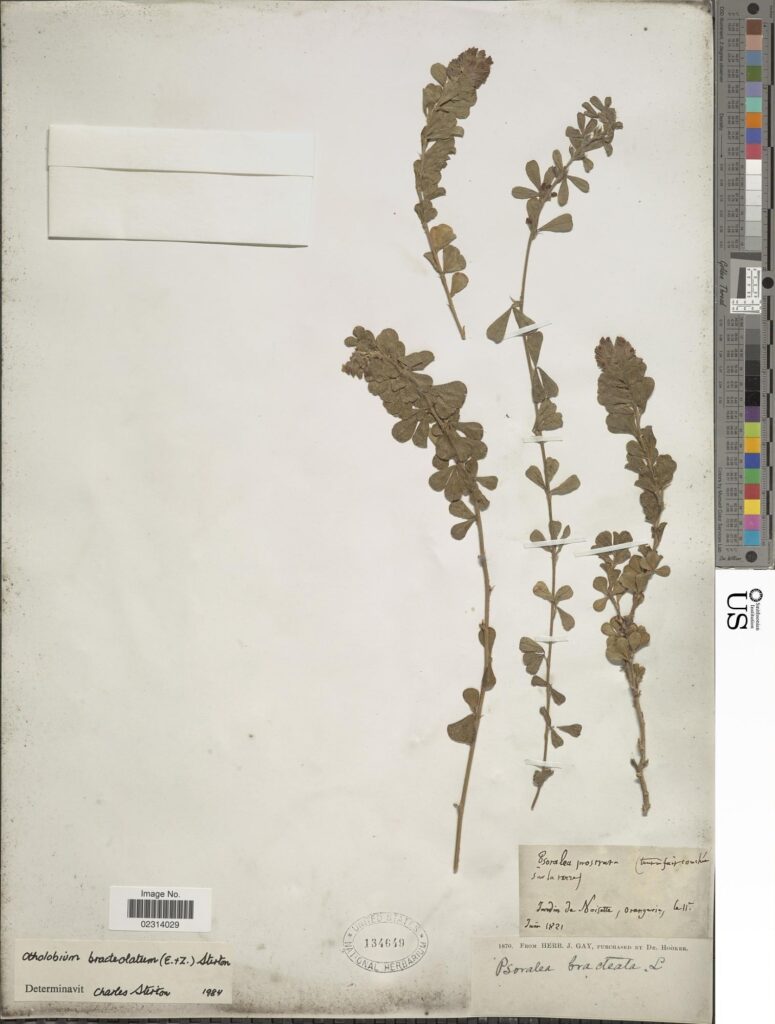
A name with history: Christian Friedrich Ecklon and Carl Ludwig Philipp Zeyher first published the name Psoralea bracteolata in 1836. Charles Stirton transferred it to Otholobium in 1986, creating the name used in SANBI’s account . The newer genus name combines Greek words meaning “to push” and “small pod”, because the fruit seems to push out of the persistent calyx; bracteolatum means “provided with small bracts”. Older material may also appear under Psoralea algoensis .